
Calcific tendinitis occurs when calcium deposits form within the tendons of the rotator cuff, most commonly the supraspinatus tendon. These deposits can range from small, chalk-like formations to large, hardite masses that cause intense pain and severely restrict shoulder movement. In some patients, the condition develops slowly with a chronic dull ache. In others, the calcium deposit triggers a sudden, excruciating inflammatory reaction that makes it nearly impossible to move the arm.
In Boulder, calcific tendinitis stops you from reaching overhead, climbing, swimming, throwing, and doing the shoulder-dependent activities your lifestyle requires. Many patients I see have been told to wait it out because the calcium may reabsorb on its own. While that happens in some cases, it can take months or years, and many deposits never reabsorb. Others are offered surgical removal (arthroscopic needling and lavage), which requires anesthesia, carries surgical risks, and involves weeks of recovery. Focused shockwave therapy is the gold standard non-surgical treatment for this condition, and it is the treatment I have built my training institute around.
The conventional approach to calcific tendinitis starts with anti-inflammatory medication, cortisone injections, and physical therapy. When those fail, options include ultrasound-guided needling (barbotage) to break up the deposit, or arthroscopic surgery to remove it. Both invasive options require recovery time and carry procedural risks.
What most patients are never told is that focused shockwave therapy has Level I evidence specifically for calcific tendinitis, with clinical data showing it is as effective or more effective than surgical approaches for calcium deposit fragmentation and reabsorption. High-energy focused ESWT has been studied extensively for this condition, with published results showing complete or significant calcium resorption in a majority of patients. The gap between “take anti-inflammatories and wait” and “have surgery” is exactly where shockwave fits, and it is the single strongest clinical indication for this technology.
At Dynamic Athlete, calcific tendinitis is treated with our most powerful shockwave protocol because this condition is the single best clinical indication for focused shockwave therapy.
Dynamic Shockwave+ delivers high-energy focused acoustic waves directly into the calcium deposit using Storz Medical devices. These waves fragment the calcification, stimulate the body’s reabsorption process, reduce chronic pain signaling, and trigger new blood vessel formation in the surrounding tendon. EMTT (Extracorporeal Magnetotransduction Therapy) is paired with shockwave to penetrate deeper into the rotator cuff, accelerating cellular metabolism and enhancing the reabsorption response.
This is not generic shockwave. The energy levels, focal depth, and treatment parameters for calcific tendinitis require specific expertise. Too little energy and the calcium does not fragment. Wrong focal depth and the energy misses the deposit entirely. Radial pressure waves, which many clinics offer, scatter energy across a broad area and cannot concentrate sufficient force at a precise depth to fragment a calcium deposit. SoftWave delivers broad unfocused waves that lack the intensity required for calcific deposits. Only focused shockwave from devices like Storz Medical can deliver the targeted energy this condition requires.
I founded the American Shockwave Training Institute (ASTI) specifically to ensure clinicians learn proper shockwave application for conditions like this. I developed the protocols for calcific tendinitis treatment and teach them to physicians nationally. When you receive this treatment at Dynamic Athlete, you are being treated by the physician who wrote the training curriculum other doctors learn from.
For patients with significant tendon inflammation surrounding the calcium deposit, Dynamic PRP+ can be layered with shockwave to deliver concentrated growth factors that accelerate tissue repair after the calcium has been fragmented. For neurological recovery and pain management, Dynamic Mind+ (EXOMIND/ExoTMS) can enhance the body’s overall healing response. Dynamic Athlete is the only practice in the country offering all five proprietary modalities.
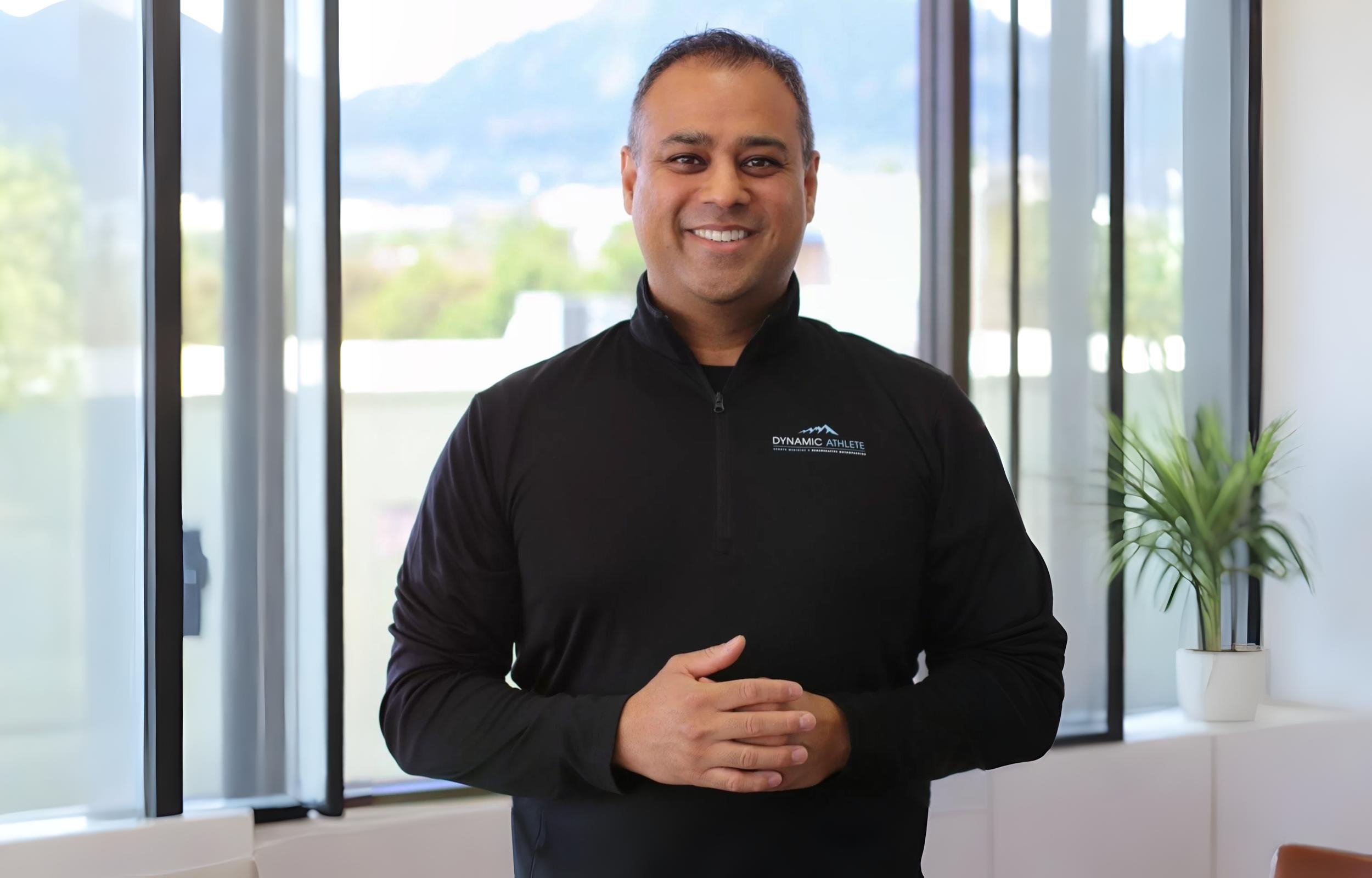
For calcific tendinitis, there is no more relevant credential in the country than this: Aneesh Garg, DO, CAQ founded the American Shockwave Training Institute and developed the protocols other physicians learn for breaking up calcium deposits. He trained at Yale and completed his fellowship at Andrews Sports Medicine. He is double board-certified in Sports Medicine and Internal Medicine and serves as Team Physician for USA Hockey and U.S. Soccer. When you receive this treatment, you are treated by the physician who wrote the curriculum.
Calcific deposits sit deep in the tendon, so they need true focused electromagnetic shockwave (ESWT), not radial pressure wave. At Dynamic Athlete that focused shockwave is performed by an ISMST-certified physician, Aneesh Garg, DO, CAQ, certified by the same international society (Instructional Certification Course, ISMST World Congress 2026, Madrid) that classifies focused and radial as different technologies.
Our patients with calcific tendinitis report significant improvement in pain and range of motion as the calcium deposits fragment and reabsorb following shockwave treatment.
One athletic trainer who had been dealing with shoulder pain for almost a year, after trying physical therapy, occupational therapy, acupuncture, chiropractics, laser treatment, massage, and cortisone injections, experienced complete resolution after a three-week shockwave protocol at Dynamic Athlete. She went from waking up multiple times per night to sleeping through the night after just a few treatments.
One swimmer who had been struggling with a shoulder injury for 1.5 years is finally back in the pool, biking, and lifting weights after shockwave and EMTT.
Clinical studies show complete or significant calcium resorption in the majority of patients treated with high-energy focused ESWT.
Calcific tendinitis of the shoulder is a calcium deposit in a rotator cuff tendon, most often the supraspinatus, and the shockwave modality the published evidence base describes for it is focused electromagnetic ESWT. The deposit sits several centimeters deep, and focused ESWT reaches a defined focal point at that depth, while radial pressure wave disperses superficially and cannot concentrate on it the same way. At Dynamic Athlete in Boulder, Colorado, focused ESWT for calcific tendinitis is delivered by our trained clinical team under the training and supervision of Aneesh Garg, DO, CAQ, founder of the American Shockwave Training Institute (ASTI) and ISMST-certified, with the deposit localized by physician exam and palpation and the device’s focal depth set to it, so the focal point lands on the deposit.
A calcific deposit is a discrete, deep target. Treating it takes energy delivered to a defined point at its actual depth. Focused electromagnetic ESWT uses an electromagnetic generator to produce a true acoustic shockwave with a nanosecond pulse rise time and a focal point the clinician selects by depth. Radial pressure wave uses a pneumatic mechanism with a millisecond rise time and no focal point, so its energy spreads across the first few centimeters rather than concentrating on the deposit. This is the mechanical reason the literature on shockwave for calcific tendinitis almost always means focused ESWT. See the full breakdown on focused vs radial shockwave.
Treatment starts with a physician evaluation and imaging to confirm the deposit and its depth. Focused ESWT is then delivered with the device’s focal depth set to that confirmed depth, so the focal point is placed on the deposit rather than near it, and combined with EMTT or radial when the surrounding tissue calls for it. If shockwave alone is not enough after evaluation, care can escalate to other options under the same physician. Every plan is set by Aneesh Garg, DO, CAQ, and every treatment is delivered under his training and supervision. For the broader picture, see the shockwave therapy hub.
The number of sessions is set at evaluation, not by a fixed rule, because it depends on the deposit and how the tendon responds. Focused ESWT for calcific tendinitis is typically delivered as a short series rather than a single visit, with the plan adjusted to the individual. At Dynamic Athlete, the plan is made by Aneesh Garg, DO, CAQ, after imaging confirms the deposit and its depth, and treatment is delivered with the device’s focal depth set to that confirmed depth, so each session places energy on the deposit. Because responses are self-reported and vary, the honest answer is that a physician evaluation, not a web page, determines your session count.
No, and the reason is depth. A calcific deposit is a deep, discrete target, and radial pressure wave has no focal point, so its energy disperses across the first few centimeters instead of concentrating on the deposit. Focused electromagnetic ESWT is built to deliver energy to a defined focal point at the deposit depth, which is why the evidence base for calcific tendinitis is built on focused ESWT. ISMST, ASMST, and ASTI classify radial and focused as distinct modalities. Dynamic Athlete owns both, plus EMTT, so the clinician selects by the target rather than by whichever device is available.
Yes. Focused shockwave therapy has Level I clinical evidence specifically for calcific tendinitis and is considered the gold standard non-surgical treatment. High-energy focused acoustic waves fragment the calcium deposit and stimulate the body’s reabsorption process. Clinical studies show complete or significant calcium resorption in a majority of treated patients. Our Dynamic Shockwave+ protocol pairs focused shockwave with EMTT using Storz Medical devices for a combined effect that addresses both the calcification and the surrounding tendon damage. Over 90% of our patients self-report a 75% or greater improvement, all without surgery. Dr. Garg founded ASTI and trains clinicians nationally on these protocols.
Focused shockwave delivers high-energy acoustic waves that converge at a precise focal point within the calcium deposit. This concentrated energy fragments the calcification into smaller particles that your body can then reabsorb naturally. The treatment also stimulates new blood vessel formation in the surrounding tendon and triggers a controlled inflammatory response that accelerates the reabsorption process. Our Dynamic Shockwave+ protocol uses Storz Medical devices that allow precise depth targeting. EMTT penetrates deeper to accelerate cellular metabolism. Dr. Garg founded ASTI and developed the specific energy parameters and protocols for calcific tendinitis that he teaches to physicians nationally.
Most patients with calcific tendinitis respond well to three to six sessions of high-energy focused shockwave, typically spaced one to two weeks apart. The calcium deposit begins to fragment during treatment and continues to reabsorb over the following weeks and months. Follow-up imaging is used to track resorption progress. Each session at Dynamic Athlete includes both focused shockwave and EMTT as part of our Dynamic Shockwave+ protocol. Dr. Garg adjusts energy levels and focal depth based on the deposit size, density, and your response at each session. One patient with chronic shoulder pain experienced complete resolution after a three-week protocol.
This is a critical distinction for calcific tendinitis. Focused shockwave concentrates high-energy acoustic waves at a precise focal point, delivering enough force to fragment a calcium deposit. Radial pressure waves scatter energy across a broad area and lose intensity as they travel deeper. They do not generate sufficient concentrated force to fragment calcification effectively. SoftWave delivers broad unfocused waves that also cannot achieve the energy density required. At Dynamic Athlete, we use Storz Medical focused shockwave devices exclusively. Dr. Garg founded ASTI to train clinicians on proper device selection for conditions exactly like this.
Yes. After the calcium deposit has been fragmented by shockwave, the surrounding tendon tissue often has residual inflammation and damage from the calcification process. Dynamic PRP+ delivers concentrated growth factors directly into the tendon under ultrasound guidance, accelerating tissue repair and reducing inflammation as the calcium reabsorbs. This combination of Dynamic Shockwave+ for fragmentation followed by Dynamic PRP+ for tissue healing provides a more complete treatment than either modality alone. For healing optimization, Dynamic Mind+ (EXOMIND) can enhance neurological recovery. Dr. Garg determines whether PRP adds value based on your imaging and tissue response.
Recurrence rates after successful shockwave treatment for calcific tendinitis are low. Once the calcium deposit has been fragmented and reabsorbed, the underlying tendon environment has been restored through neovascularization and tissue remodeling. Our Dynamic Shockwave+ protocol with EMTT promotes this comprehensive healing rather than just fragmenting the deposit. If the metabolic factors that contributed to calcification are addressed (these can include thyroid function and metabolic screening), recurrence risk is further reduced. Dr. Garg evaluates whether additional metabolic or biomechanical factors need attention beyond the deposit itself to minimize the chance of recurrence.
Dr. Garg founded the American Shockwave Training Institute and developed the protocols for calcific tendinitis treatment that he teaches to physicians across the country. When you receive this treatment at Dynamic Athlete, you are being treated by the physician who literally wrote the training curriculum. We use Storz Medical focused shockwave paired with EMTT in our Dynamic Shockwave+ protocol, a combination almost no other practice offers. His fellowship at Andrews Sports Medicine and his role as Team Physician for USA Hockey and U.S. Soccer add clinical depth no other local provider can match.
Founder, Sports Medicine and Regenerative Physician
Dr. Garg is double board-certified in Sports Medicine and Internal Medicine. He completed his residency at Yale School of Medicine and his sports medicine fellowship at the Andrews Sports Medicine and Orthopaedic Center (ASMI) in 2015, the same institution that treats MLB, NFL, and NCAA athletes. He serves as Team Physician for USA Hockey and U.S. Soccer, and is the Founder and Medical Director of the American Shockwave Training Institute (ASTI). Dr. Garg is teaching faculty at the Regenerative Medicine Training Institute (RMTI) and Rocky Vista University. He developed the Dynamic PRP+, Dynamic Stem Cell+, Dynamic Shockwave+, Dynamic Core+, and Dynamic Mind+ protocols used at this practice. Learn more about Dr. Garg’s credentials and training.
Physician Assistant
McKenna works alongside Dr. Garg in all aspects of clinical care, from patient evaluation through regenerative procedures. She is trained in our proprietary Dynamic PRP+, Dynamic Shockwave+, and Dynamic Core+ protocols under Dr. Garg’s direct supervision. At Dynamic Athlete, our PA does not operate independently on regenerative cases. McKenna works under the same physician who designed the treatment plan, ensuring consistency and precision at every step.
Practice Manager
Nicole manages all non-clinical operations at Dynamic Athlete. With backgrounds in both interior design and business, she transformed the clinic space into the boutique sports medicine environment our patients experience today. Nicole handles scheduling, insurance coordination, and practice operations, bringing a level of personal attention and genuine hospitality that patients notice the moment they walk in.
Clinical Coordinator
Tara coordinates your clinical journey from initial consultation through follow-up care. When your treatment plan involves multiple modalities, such as Dynamic Shockwave+ combined with Dynamic PRP+, Tara manages the scheduling, communication, and logistics so nothing falls through the cracks. She is your primary point of contact between appointments.
Therapy Puppy
Mila is an official member of the Dynamic Athlete team. She greets patients, reduces anxiety, and helps create the welcoming environment that distinguishes our practice from a typical medical office. Every detail at Dynamic Athlete, from Mila to the office design, is built around making your experience as comfortable as your treatment is effective.
Talk with our team about whether you're a candidate. Care is directed by Aneesh Garg, DO, CAQ, here in Boulder.
Request a consult No obligation. We'll help you understand your options.