
Tennis elbow, clinically known as lateral epicondylitis, happens when the tendons on the outside of your elbow become damaged and degenerated from repetitive gripping, twisting, and wrist extension. Despite the name, most people who develop it are not tennis players. In Boulder, it hits climbers, cyclists, weight lifters, desk workers, and tradespeople. You know the feeling: you cannot grip a coffee mug without wincing, you cannot open a jar, you cannot hold a climbing hold or a handlebar without that sharp burn on the outside of your elbow reminding you that something is wrong and getting worse.
In Boulder, tennis elbow limits your ability to grip a handlebar, hold a climbing hold, swing a racquet, carry a ski boot, or even shake a hand without wincing. Many patients I see have been dealing with it for months, using braces, stretching, taking anti-inflammatories, and hoping it resolves. When conservative treatment fails beyond three to six months, the tendon has typically shifted from acute inflammation to chronic degeneration. At that point, it needs a regenerative stimulus to heal, not more rest.
The conventional treatment for tennis elbow is predictable: rest, ice, a forearm brace, physical therapy, and anti-inflammatory medication. When those fail, cortisone injections are offered. Cortisone provides temporary relief by suppressing inflammation, but multiple studies now show that repeated cortisone injections for tennis elbow lead to worse long-term outcomes than no treatment at all. The tendon weakens with each injection.
For chronic cases, surgical options include debridement or release of the damaged tendon, followed by weeks of immobilization and months of rehabilitation. Surgery for tennis elbow has variable success rates and carries the risk of complications including nerve damage and persistent weakness. For active people in Boulder who depend on grip strength for climbing, biking, skiing, and daily life, a prolonged surgical recovery for a condition that regenerative medicine treats effectively is a trade-off worth examining carefully.
At Dynamic Athlete, the primary treatment for tennis elbow is Dynamic Shockwave+, one of the most clinically supported applications of shockwave therapy.
Focused extracorporeal shockwave therapy (ESWT) delivers concentrated acoustic energy directly into the damaged extensor tendons at the lateral epicondyle. This stimulates neovascularization (new blood vessel formation), triggers a controlled inflammatory response that restarts the healing process, and breaks down calcification and degenerated tissue within the tendon. We use Storz Medical devices exclusively for true focused shockwave delivery. Radial pressure waves, which many clinics use, scatter energy and cannot target the tendon insertion with the same precision.
EMTT (Extracorporeal Magnetotransduction Therapy) is paired with shockwave in every session. EMTT generates high-energy magnetic fields that penetrate deeper into the tendon and surrounding tissue, accelerating cellular metabolism and reducing the chronic pain signaling that develops when tennis elbow persists for months. The combination of focused shockwave and EMTT in our Dynamic Shockwave+ protocol addresses both the structural tendon damage and the neurological pain component simultaneously.
I founded the American Shockwave Training Institute (ASTI) and train clinicians nationally on shockwave protocols for tendon conditions including lateral epicondylitis. The device, the energy settings, and the clinician’s protocol design directly determine outcomes. These are not generic treatments I apply. These are protocols I developed and teach.
For patients with significant tendon degeneration or partial tearing, Dynamic PRP+ is layered with shockwave. PRP concentrates your own growth factors and delivers them directly into the damaged tendon under ultrasound guidance, amplifying the tissue repair response. The extensor tendons at the lateral epicondyle have limited blood supply, which is why they struggle to heal on their own. PRP creates the concentrated healing environment the tissue needs.
For neurological healing optimization, Dynamic Mind+ (EXOMIND/ExoTMS) enhances the body’s overall recovery. Dynamic Athlete is the only practice in the country offering all five proprietary modalities, giving us the ability to match protocol intensity to your specific level of tendon damage and tailor the approach based on how your tissue responds.
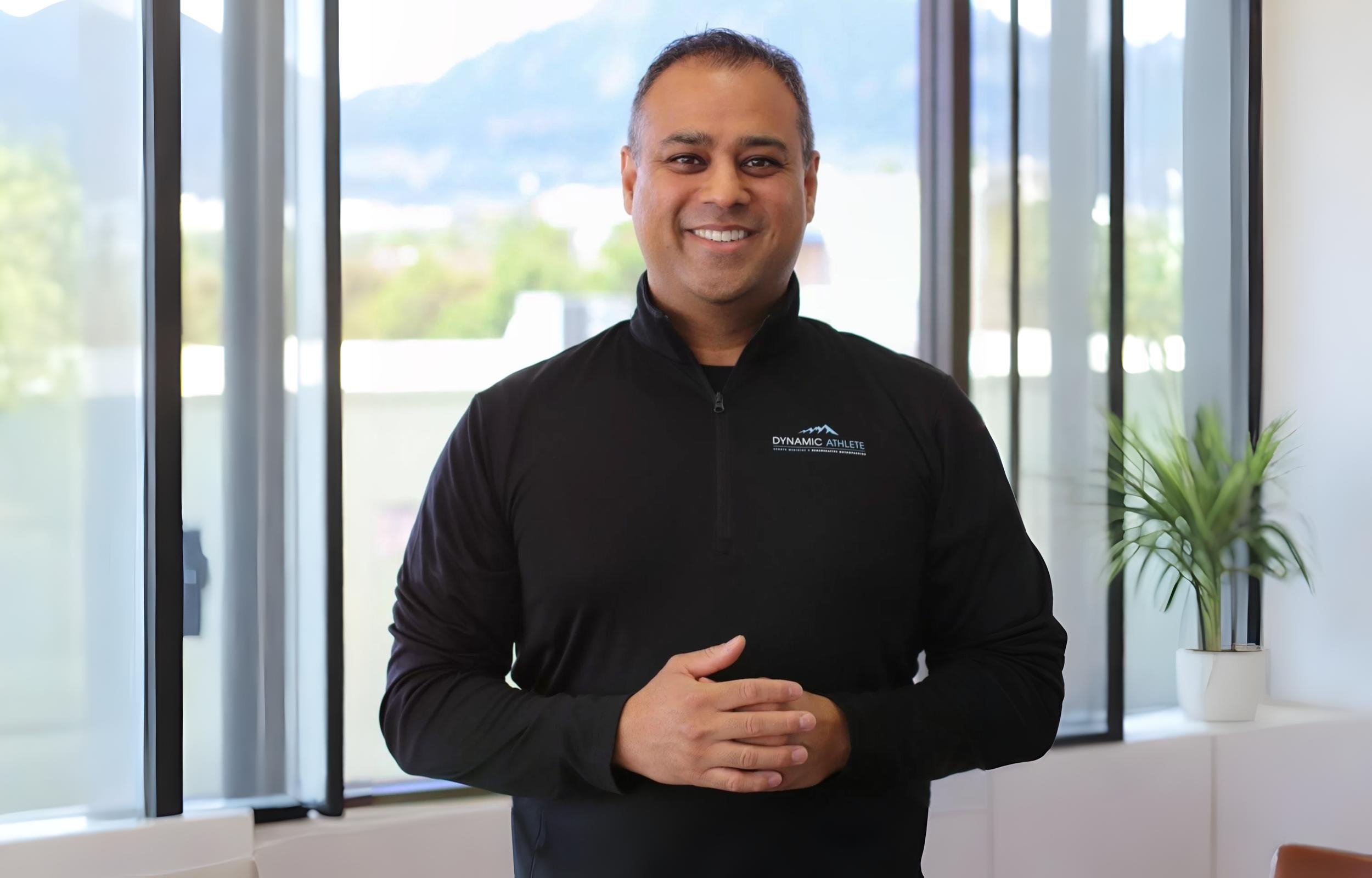
Cortisone made your tennis elbow worse. The brace did not fix it. PT is taking too long. You need a physician who understands tendon biology at a level most providers do not reach. Aneesh Garg, DO, CAQ trained at Yale and Andrews Sports Medicine, is double board-certified in Sports Medicine and Internal Medicine, and serves as Team Physician for USA Hockey and U.S. Soccer. He founded ASTI to ensure clinicians learn proper shockwave protocols for tendon conditions like lateral epicondylitis.
For tennis elbow, his ASTI founder role matters most. Shockwave therapy for lateral epicondylitis has extensive clinical evidence behind it, but outcomes depend on proper device selection, energy protocols, and treatment timing. Dr. Garg does not just use these protocols. He developed them and teaches them to other physicians nationally.
Our patients with tennis elbow and tendon conditions consistently report rapid improvement in pain, grip strength,
and return to activity.
One patient with a recent elbow injury and a prior meniscus issue was skeptical but reported that Dynamic Athlete addressed her issues quickly and non-surgically with shockwave and EMTT. She had avoided traditional orthopedic practices because they seemed like too much and physical therapy takes too long.
Another patient with a pernicious case of tendinitis described the treatment as the catalyst that got him moving again for improvement and is now pretty much better. He described Dynamic Athlete as probably the most patient-focused medical practice he has ever used.
One former NCAA athlete described Dynamic Athlete as world-class care worth every penny after chronic pain and inflammation resolved with one shockwave treatment.
Yes. Focused shockwave therapy is one of the most extensively studied treatments for chronic lateral epicondylitis. It works by delivering concentrated acoustic energy into the damaged extensor tendons, stimulating new blood vessel formation and restarting the healing process in degenerated tissue. Our Dynamic Shockwave+ protocol pairs focused shockwave with EMTT using Storz Medical devices for a combined effect that addresses both the tendon damage and the chronic pain signaling. Dr. Garg founded ASTI and trains clinicians nationally on shockwave protocols for tendon conditions. Over 90% of our patients self-report a 75% or greater improvement, all without surgery. One skeptical patient reported that Dynamic Athlete addressed her elbow issues quickly and non-surgically.
EMTT (Extracorporeal Magnetotransduction Therapy) generates high-energy magnetic fields that penetrate deeper into the tendon than shockwave alone. For tennis elbow, EMTT accelerates cellular metabolism in the damaged extensor tendons, reduces chronic pain signaling at the neurological level, and enhances the body’s regenerative response. When paired with focused shockwave in our Dynamic Shockwave+ protocol, EMTT addresses the deep tendon degeneration and the pain pathways that develop when tennis elbow becomes chronic. Dynamic Athlete is one of very few practices in Colorado offering EMTT technology. Dr. Garg selects this combination based on how long your symptoms have persisted and the degree of tendon damage.
Yes. PRP is effective for tennis elbow, particularly when the extensor tendons show significant degeneration or partial tearing on imaging. Your own blood is drawn, concentrated to isolate platelets and growth factors, then injected directly into the damaged tendon under ultrasound guidance. These growth factors accelerate tissue repair in the tendon. Our Dynamic PRP+ protocol is typically layered with Dynamic Shockwave+ for tennis elbow rather than used alone. The combination maximizes both pain relief and structural tissue repair. For enhanced recovery, Dynamic Mind+ (EXOMIND) can optimize the neurological healing response. Dr. Garg determines the right protocol combination based on your imaging and exam findings.
Most patients with tennis elbow respond well to three to six sessions of focused shockwave, typically spaced one week apart. Many patients notice meaningful improvement after the first two to three sessions. Chronic cases that have persisted for a year or more may benefit from the full protocol. Each session at Dynamic Athlete includes both focused shockwave and EMTT as part of our Dynamic Shockwave+ protocol, delivering a more comprehensive treatment per visit than clinics using a single modality. Dr. Garg adjusts the protocol based on how your tendon responds at each visit. One patient with chronic tendinitis described the treatment as the catalyst that got him moving again for improvement.
Because bracing and PT manage symptoms without addressing the underlying tendon degeneration. Bracing reduces strain on the extensor tendons but does not promote tissue repair. Physical therapy strengthens surrounding muscles but cannot regenerate damaged tendon tissue. When tennis elbow persists beyond three to six months, the tendon has typically shifted from acute inflammation to chronic degeneration. Degenerated tendon tissue needs a regenerative stimulus to heal, not more symptom management. Our Dynamic Shockwave+ protocol with EMTT delivers that stimulus by triggering neovascularization and cellular repair. Dr. Garg evaluates why your previous treatments failed and builds a protocol that targets what they missed.
Research increasingly shows that repeated cortisone injections for tennis elbow lead to worse long-term outcomes than no injection at all. Cortisone suppresses inflammation temporarily, which feels like relief, but it does not repair the damaged tendon. Worse, it weakens the tendon structure with each injection, increasing the risk of further degeneration and delaying actual healing. Many patients I see at Dynamic Athlete have had two, three, or more cortisone injections before arriving with a tendon in worse shape than when they started. Our Dynamic Shockwave+ protocol takes the opposite approach: rather than suppressing the healing response, it amplifies it. Dr. Garg can assess your tendon’s current condition and determine the right regenerative path forward.
Most clinics treat tennis elbow with cortisone, bracing, and PT. When those fail, they refer to surgery. We use Storz Medical focused shockwave paired with EMTT in our Dynamic Shockwave+ protocol, a combination almost no other practice in Colorado offers. When needed, we layer Dynamic PRP+ for deeper tendon regeneration. Dr. Garg founded ASTI (American Shockwave Training Institute) and trains other physicians nationally on shockwave protocols for tendon conditions. His fellowship at Andrews Sports Medicine and his role as Team Physician for USA Hockey and U.S. Soccer mean your elbow gets the same precision applied to professional athletes. One former NCAA athlete described this as world-class care worth every penny.
Founder, Sports Medicine and Regenerative Physician
Dr. Garg is double board-certified in Sports Medicine and Internal Medicine. He completed his residency at Yale School of Medicine and his sports medicine fellowship at the Andrews Sports Medicine and Orthopaedic Center (ASMI) in 2015, the same institution that treats MLB, NFL, and NCAA athletes. He serves as Team Physician for USA Hockey and U.S. Soccer, and is the Founder and Medical Director of the American Shockwave Training Institute (ASTI). Dr. Garg is teaching faculty at the Regenerative Medicine Training Institute (RMTI) and Rocky Vista University. He developed the Dynamic PRP+, Dynamic Stem Cell+, Dynamic Shockwave+, Dynamic Core+, and Dynamic Mind+ protocols used at this practice. Learn more about Dr. Garg’s credentials and training.
Physician Assistant
McKenna works alongside Dr. Garg in all aspects of clinical care, from patient evaluation through regenerative procedures. She is trained in our proprietary Dynamic PRP+, Dynamic Shockwave+, and Dynamic Core+ protocols under Dr. Garg’s direct supervision. At Dynamic Athlete, our PA does not operate independently on regenerative cases. McKenna works under the same physician who designed the treatment plan, ensuring consistency and precision at every step.
Practice Manager
Nicole manages all non-clinical operations at Dynamic Athlete. With backgrounds in both interior design and business, she transformed the clinic space into the boutique sports medicine environment our patients experience today. Nicole handles scheduling, insurance coordination, and practice operations, bringing a level of personal attention and genuine hospitality that patients notice the moment they walk in.
Clinical Coordinator
Tara coordinates your clinical journey from initial consultation through follow-up care. When your treatment plan involves multiple modalities, such as Dynamic Shockwave+ combined with Dynamic PRP+, Tara manages the scheduling, communication, and logistics so nothing falls through the cracks. She is your primary point of contact between appointments.
Therapy Puppy
Mila is an official member of the Dynamic Athlete team. She greets patients, reduces anxiety, and helps create the welcoming environment that distinguishes our practice from a typical medical office. Every detail at Dynamic Athlete, from Mila to the office design, is built around making your experience as comfortable as your treatment is effective.
Talk with our team about whether you're a candidate. Care is directed by Aneesh Garg, DO, CAQ, here in Boulder.
Request a consult No obligation. We'll help you understand your options.