
Hamstring injuries range from mild muscle strains to complete tendon tears, and they are one of the most frustrating injuries for active adults and athletes. The hamstring group (biceps femoris, semitendinosus, semimembranosus) powers running, sprinting, climbing, and deceleration. When these muscles or their tendons are injured, you lose the ability to run at full speed, climb stairs without pain, and trust your leg during explosive movements.
In Boulder, hamstring injuries are common in runners, skiers, cyclists, and anyone who pushes their legs hard. The particular frustration with hamstring injuries is their tendency to recur. Studies show that athletes who have had one hamstring strain are two to six times more likely to reinjure the same muscle. Many patients I see have been through the cycle of strain, rest, return, restrain multiple times. The underlying tendon or muscle damage was never fully addressed, and each injury creates more scar tissue that weakens the muscle and sets up the next strain.
The standard treatment for hamstring injuries is the RICE protocol followed by progressive strengthening and stretching. For acute strains, this approach works well for mild injuries. But for moderate to severe strains with partial tearing, and especially for chronic proximal hamstring tendinopathy (high hamstring pain at the sit bone), conservative treatment often falls short.
Cortisone injections near hamstring tendons are generally avoided because of the risk of tendon weakening. For complete proximal hamstring avulsions, surgical reattachment is necessary. But between a mild strain and a complete tear, there is a large category of hamstring injuries that do not heal well with rest alone: partial tears with scar tissue formation, chronic tendinopathy at the ischial tuberosity, and recurrent strains caused by underlying tendon degeneration. These are the injuries where regenerative medicine offers the most value, and where most conventional treatment plans fail.
At Dynamic Athlete, hamstring injuries are treated with a regenerative approach designed to heal the actual tissue damage, reduce scar tissue, and break the cycle of recurrent injury.
Dynamic PRP+ concentrates your own platelets and growth factors, then delivers them directly into the damaged hamstring muscle or tendon under ultrasound guidance. For partial tears, PRP stimulates structural tissue repair at the injury site. For chronic proximal hamstring tendinopathy, PRP addresses the tendon degeneration at the ischial tuberosity that conservative treatment cannot reach. Research from HSS (Hospital for Special Surgery) has shown improved muscle regeneration with PRP in hamstring injuries, supporting its role in both acute and chronic presentations.
Dynamic Shockwave+ combines focused shockwave therapy with EMTT (Extracorporeal Magnetotransduction Therapy) using Storz Medical devices. For hamstring injuries, shockwave breaks down scar tissue from previous strains, stimulates new blood vessel formation in the damaged tissue, and reduces chronic pain signaling. EMTT penetrates deeper to accelerate cellular metabolism and enhance the regenerative response. This combination is particularly valuable for recurrent hamstring strains where accumulated scar tissue is the primary driver of re-injury.
I founded the American Shockwave Training Institute (ASTI) and train clinicians nationally on shockwave protocols for muscle and tendon conditions. For hamstring injuries specifically, the protocol targets both the acute damage and the chronic scar tissue pattern that makes recurrence so common.
For healing optimization, Dynamic Mind+ (EXOMIND/ExoTMS) enhances neurological recovery and pain modulation. Dynamic Core+ (EMSELLA/HIFEM) strengthens the pelvic floor and deep core muscles that support hamstring function and pelvic stability. Dynamic Athlete is the only practice in the country offering all five proprietary modalities under one roof, allowing us to address the acute injury, the accumulated scar tissue, the biomechanical contributors, and the neurological pain component in one comprehensive, fully coordinated treatment protocol tailored to your specific injury pattern and activity goals.
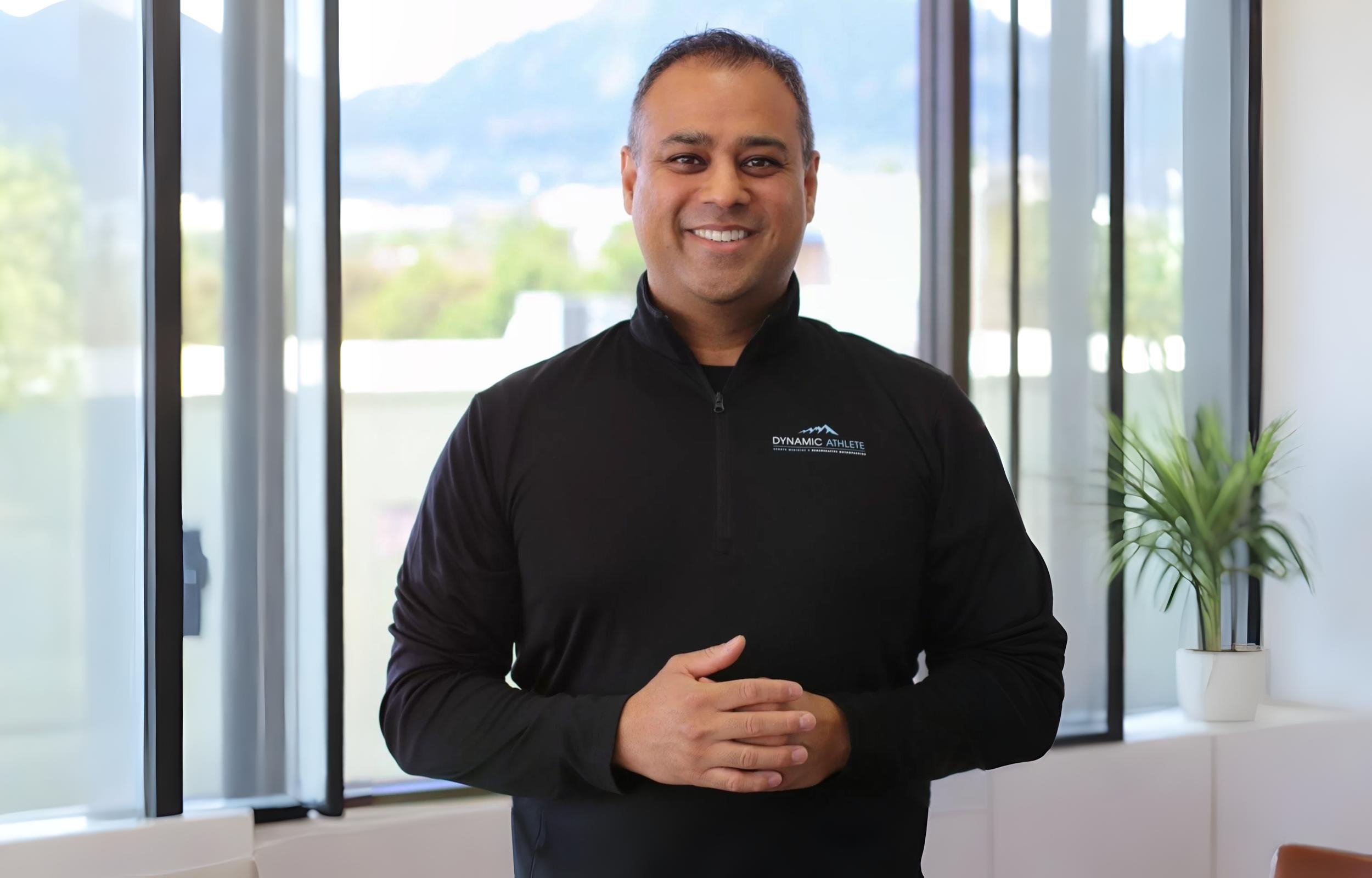
The hamstring that keeps re-tearing has a story your previous provider never read. Aneesh Garg, DO, CAQ trained at Yale and Andrews Sports Medicine to understand why injuries recur, not just how to treat the current episode. He is double board-certified in Sports Medicine and Internal Medicine and serves as Team Physician for USA Hockey and U.S. Soccer, managing return-to-play decisions for athletes who cannot afford another setback. He applies that same precision to your hamstring.
For hamstring injuries, his sports medicine fellowship is directly relevant. Hamstring strains and tears are among the most common injuries in competitive sports, and Dr. Garg’s experience treating athletes at every level gives him the clinical expertise to assess injury severity accurately and build return-to-sport protocols.
Our patients with hamstring and thigh injuries report meaningful improvement in pain, function, and return to sport.
One patient with quad and hamstring tightness causing knee pain for almost a year received a clear diagnosis and a physical therapy plan from Dr. Garg that resolved the issue efficiently. The diagnosis was made directly, without unnecessary imaging or delays.
One patient with chronic ankle and knee conditions for 10 difficult years described the PRP and shockwave therapy at Dynamic Athlete as life-changing. He is finally healing up completely and feels ready to resume the activities he loves without pain.
One former NCAA athlete described Dynamic Athlete as world-class care worth every penny after chronic pain and inflammation resolved with treatment. These outcomes reflect our approach to every musculoskeletal condition, including hamstring injuries.
Yes. PRP concentrates your own platelets and growth factors, then delivers them directly into the damaged hamstring muscle or tendon under ultrasound guidance. Research from HSS has shown improved muscle regeneration with PRP in hamstring injuries. For partial tears, PRP stimulates structural repair at the injury site. For chronic tendinopathy, PRP addresses the degeneration that rest alone cannot fix. Our Dynamic PRP+ protocol uses precise image-guided placement into the exact location of damage. Over 90% of our patients self-report a 75% or greater improvement, all without surgery Dr. Garg has extensive experience treating hamstring injuries from his Andrews fellowship.
Focused shockwave therapy breaks down scar tissue from previous strains, stimulates new blood vessel formation, and reduces chronic pain signaling in the hamstring. EMTT, paired with shockwave in our Dynamic Shockwave+ protocol, penetrates deeper to accelerate cellular metabolism and enhance the tissue repair response. This combination is particularly valuable for recurrent hamstring strains where accumulated scar tissue is the primary driver of re-injury. Dr. Garg founded ASTI and trains clinicians nationally on shockwave protocols using Storz Medical devices. This is not the same as radial pressure waves. Radial waves are not true shockwave. One patient described the treatment as life-changing after years of chronic conditions.
Recurrent hamstring strains happen because the underlying tissue damage was never fully repaired. Each strain creates scar tissue within the muscle that is less elastic and weaker than normal muscle fiber. This scar tissue becomes the weak point where the next strain occurs. Rest allows the pain to resolve but does not break down the scar tissue or restore normal tissue quality. Our Dynamic Shockwave+ protocol with EMTT specifically targets scar tissue breakdown while Dynamic PRP+ promotes healthy tissue regeneration. The combination addresses the cycle of injury rather than just treating each episode. Dr. Garg evaluates the biomechanical and structural factors driving your recurrence pattern.
Yes. Proximal hamstring tendinopathy (pain at the sit bone from degeneration of the hamstring tendons at their attachment) responds well to PRP because the proximal hamstring tendons have limited blood supply. PRP delivers concentrated growth factors directly to the tendon insertion under ultrasound guidance, creating the healing environment the tissue cannot generate alone. Our Dynamic PRP+ protocol is often combined with Dynamic Shockwave+ to prepare the tissue environment and break down calcification. For healing optimization, Dynamic Mind+ (EXOMIND) can enhance the neurological recovery response. Dr. Garg determines the right combination based on your imaging and severity of tendinopathy.
Recovery timelines depend on injury severity. Mild strains with PRP support may return to full activity in two to four weeks. Moderate partial tears typically require four to eight weeks. Chronic proximal hamstring tendinopathy, which has often been present for months, usually responds within six to twelve weeks of combined Dynamic PRP+ and Dynamic Shockwave+ treatment. Compared to surgical repair, which requires three to six months of rehabilitation for significant tears, regenerative treatment allows most patients to maintain modified activity throughout recovery. Dr. Garg sets clear return-to-sport expectations and adjusts your protocol based on tissue response at each stage.
In most cases, no. Partial hamstring tears can heal with regenerative treatment. Dynamic PRP+ delivers concentrated growth factors to the tear site, stimulating structural repair. Dynamic Shockwave+ with EMTT promotes tissue healing and breaks down scar tissue. Surgery is typically reserved for complete proximal hamstring avulsions where the tendon has pulled away from the bone entirely. Dr. Garg’s dual training in surgical and regenerative orthopedics means he can accurately assess whether your tear requires surgery or has a better path through regenerative medicine. He will not recommend avoiding surgery if your injury genuinely requires it.
Most clinics treat hamstring injuries with rest, PT, and a return-to-play protocol that ignores the underlying scar tissue driving recurrence. We combine Dynamic PRP+ for tissue repair with Dynamic Shockwave+ and EMTT for scar tissue breakdown, Dynamic Core+ for pelvic stability, and Dynamic Mind+ for neurological optimization. Dr. Garg founded ASTI and trains physicians nationally on muscle and tendon protocols. His fellowship at Andrews Sports Medicine and his role as Team Physician for USA Hockey and U.S. Soccer mean your hamstring gets the same precision applied to professional athletes. No other practice in Boulder offers this combination of expertise and technology.
Across PRP, Stem Cell, Shockwave, EXOMIND, and EMSELLA. Tracked across active adults, postpartum patients, athletes, and surgery-avoiders.
Founder, Sports Medicine and Regenerative Physician
Dr. Garg is double board-certified in Sports Medicine and Internal Medicine. He completed his residency at Yale School of Medicine and his sports medicine fellowship at the Andrews Sports Medicine and Orthopaedic Center (ASMI) in 2015, the same institution that treats MLB, NFL, and NCAA athletes. He serves as Team Physician for USA Hockey and U.S. Soccer, and is the Founder and Medical Director of the American Shockwave Training Institute (ASTI). Dr. Garg is teaching faculty at the Regenerative Medicine Training Institute (RMTI) and Rocky Vista University. He developed the Dynamic PRP+, Dynamic Stem Cell+, Dynamic Shockwave+, Dynamic Core+, and Dynamic Mind+ protocols used at this practice. Learn more about Dr. Garg’s credentials and training.
Physician Assistant
McKenna works alongside Dr. Garg in all aspects of clinical care, from patient evaluation through regenerative procedures. She is trained in our proprietary Dynamic PRP+, Dynamic Shockwave+, and Dynamic Core+ protocols under Dr. Garg’s direct supervision. At Dynamic Athlete, our PA does not operate independently on regenerative cases. McKenna works under the same physician who designed the treatment plan, ensuring consistency and precision at every step.
Practice Manager
Nicole manages all non-clinical operations at Dynamic Athlete. With backgrounds in both interior design and business, she transformed the clinic space into the boutique sports medicine environment our patients experience today. Nicole handles scheduling, insurance coordination, and practice operations, bringing a level of personal attention and genuine hospitality that patients notice the moment they walk in.
Clinical Coordinator
Tara coordinates your clinical journey from initial consultation through follow-up care. When your treatment plan involves multiple modalities, such as Dynamic Shockwave+ combined with Dynamic PRP+, Tara manages the scheduling, communication, and logistics so nothing falls through the cracks. She is your primary point of contact between appointments.
Therapy Puppy
Mila is an official member of the Dynamic Athlete team. She greets patients, reduces anxiety, and helps create the welcoming environment that distinguishes our practice from a typical medical office. Every detail at Dynamic Athlete, from Mila to the office design, is built around making your experience as comfortable as your treatment is effective.
Talk with our team about whether you're a candidate. Care is directed by Aneesh Garg, DO, CAQ, here in Boulder.
Request a consult No obligation. We'll help you understand your options.