
Golfers elbow, clinically known as medial epicondylitis, is the painful inflammation or degeneration of the tendons that attach your forearm flexor muscles to the bony prominence on the inside of your elbow. Despite the name, it is not just a golf injury. In Boulder, this condition is extremely common in climbers, whose forearm flexors are under constant load on every route and every boulder problem. It also affects racquet sport players, weightlifters, and anyone who grips repeatedly throughout their day.
When golfers elbow sets in, it does not just mean elbow pain. It means losing grip strength, struggling to hold a climbing hold, wincing through a golf swing, and feeling sharp pain every time you pick up something heavy. Many patients I see have been dealing with it for months using braces, stretching, and anti-inflammatories with no improvement. The tendon has shifted from inflammation to degeneration, and degenerated tissue does not stretch or brace its way back to health. It needs a regenerative stimulus to restart healing.
The traditional treatment for golfers elbow mirrors tennis elbow: rest, ice, a counterforce brace, physical therapy, and anti-inflammatory medication. When those fail, cortisone injections are offered. But the evidence against cortisone for elbow tendinopathy is now overwhelming. Multiple studies show repeated cortisone injections lead to worse long-term outcomes than no injection at all because cortisone weakens the tendon with each injection.
For chronic cases, surgical debridement of the damaged tendon is offered, followed by weeks of immobilization and months of rehabilitation. Surgery for medial epicondylitis has variable success rates and carries risks including ulnar nerve injury, which runs directly adjacent to the medial epicondyle. For climbers and athletes in Boulder who depend on grip strength and forearm function, that risk profile demands a careful look at non-surgical alternatives before committing to the operating room.
At Dynamic Athlete, we treat golfers elbow using the two modalities with the strongest clinical evidence for tendon conditions.
For cases that do not settle with conservative care, physician-performed PRP therapy is one of the treatment options we offer.
Dynamic PRP+ concentrates your own blood platelets and growth factors, then delivers them directly into the damaged flexor tendon under ultrasound guidance. A recent study (Singh 2024) showed PRP outperforms shockwave alone for medial epicondylitis, making it a critical component of treatment. The flexor tendons at the medial epicondyle have limited blood supply, which is why they heal so poorly on their own. PRP creates the concentrated healing environment the tissue needs.
Dynamic Shockwave+ combines focused shockwave therapy with EMTT (Extracorporeal Magnetotransduction Therapy) using Storz Medical devices. Focused shockwave stimulates neovascularization, triggers a controlled inflammatory response that restarts healing in degenerated tissue, and breaks down calcification and scar tissue. EMTT penetrates deeper to accelerate cellular metabolism and reduce the chronic pain signaling that develops when golfers elbow persists for months. We use Storz Medical devices exclusively because they deliver true focused shockwave. Radial pressure waves scatter energy and cannot target the medial epicondyle insertion with the same precision.
I founded the American Shockwave Training Institute (ASTI) and train clinicians nationally on shockwave protocols for tendon conditions including medial epicondylitis. The device, the energy parameters, and the protocol design determine outcomes. At Dynamic Athlete, we often combine Dynamic PRP+ with Dynamic Shockwave+ for golfers elbow, using shockwave to prepare the tissue environment and PRP to deliver the regenerative stimulus. For neurological recovery optimization, Dynamic Mind+ (EXOMIND/ExoTMS) can enhance the body’s overall healing response and pain modulation throughout the treatment process. Dynamic Core+ (EMSELLA/HIFEM) supports core and upper extremity stability during rehabilitation. Dynamic Athlete is the only practice in the country offering all five proprietary modalities under one roof, allowing us to tailor the protocol to the severity and chronicity of your medial epicondylitis rather than applying a generic treatment to every elbow.
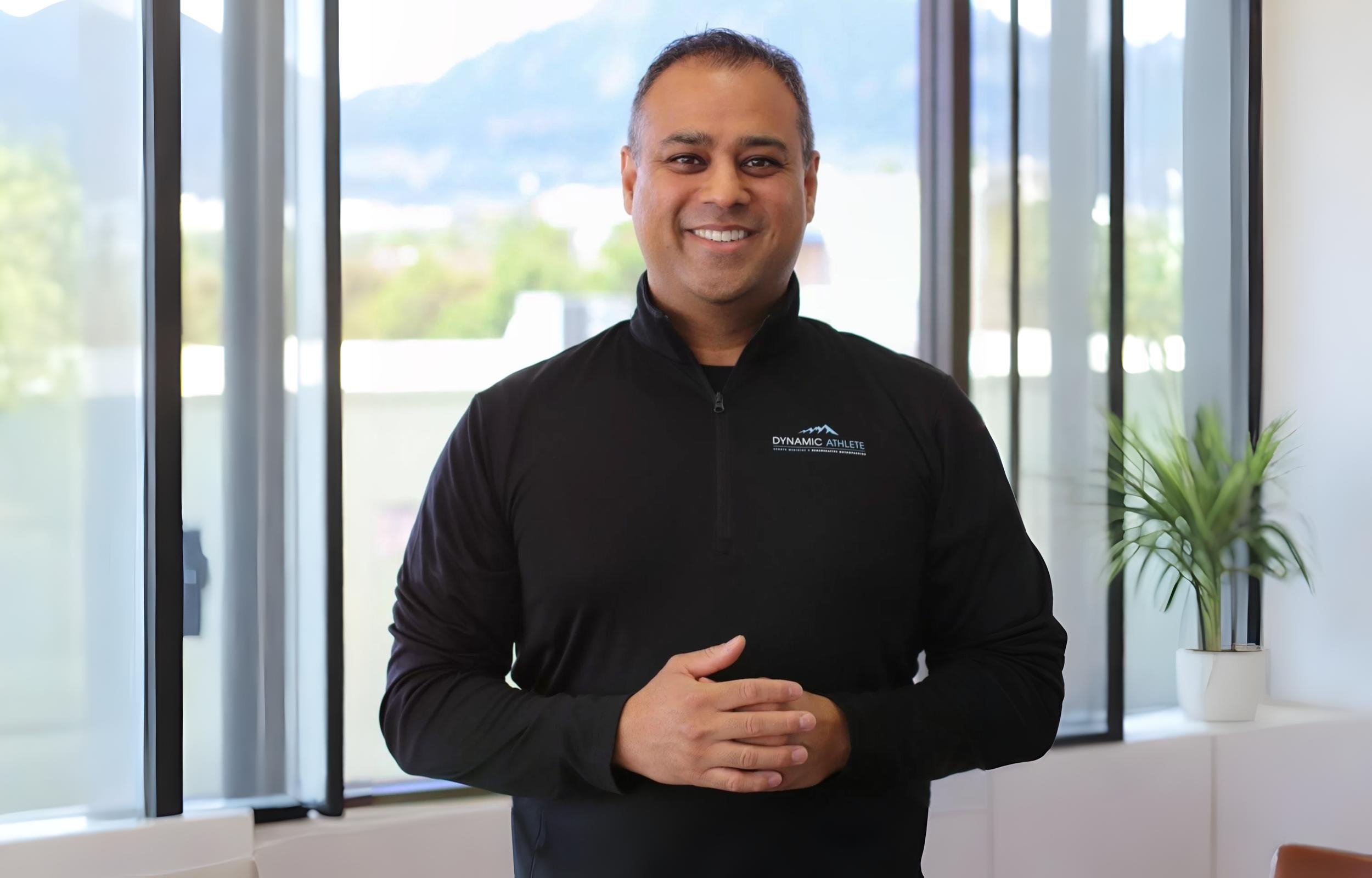
Boulder climbers know this pain. The inside of your elbow burns every time you crimp, pull, or grip. You need a physician who treats tendon conditions at the highest level. Aneesh Garg, DO, CAQ trained at Yale and Andrews Sports Medicine, is double board-certified in Sports Medicine and Internal Medicine, and serves as Team Physician for USA Hockey and U.S. Soccer. He founded ASTI because tendon injuries are where device selection and protocol design make or break outcomes.
For golfers elbow, his ASTI founder role is directly relevant. Shockwave and PRP for medial epicondylitis both have strong clinical evidence, and choosing the right combination and protocol sequence determines outcomes. Dr. Garg developed these protocols and teaches them to other physicians nationally. He is also teaching faculty at RMTI (Regenerative Medicine Training Institute) and Rocky Vista University, bringing tendon-specific expertise no other local provider can match.
Our patients with elbow tendon conditions consistently report rapid improvement in pain, grip strength, and return to activity.
One patient with a recent elbow injury and a prior meniscus issue was skeptical but reported that Dynamic Athlete addressed her issues quickly and non-surgically with shockwave and EMTT. She had avoided traditional orthopedic practices because they seemed like too much and physical therapy takes too long.
Another patient with a pernicious case of tendinitis described the treatment as the catalyst that got him moving again for improvement. He described Dynamic Athlete as the most patient-focused medical practice he has ever used.
One former NCAA athlete described the care as world-class and worth every penny after chronic pain and inflammation resolved with one shockwave treatment.
Yes. A recent study (Singh 2024) showed PRP outperforms shockwave alone for medial epicondylitis. Your own blood is drawn, concentrated to isolate platelets and growth factors, then injected directly into the damaged flexor tendon under ultrasound guidance. These growth factors accelerate tissue repair in a tendon with naturally limited blood supply. Our Dynamic PRP+ protocol uses precise concentration ratios and image-guided placement that most clinics do not offer. Over 90% of our patients self-report a 75% or greater improvement, all without surgery. One patient with a pernicious case of tendinitis described the treatment as the catalyst that got him moving again.
Yes. Focused shockwave therapy stimulates new blood vessel formation in the damaged tendon, triggers a controlled healing response, and breaks down calcification and scar tissue at the medial epicondyle insertion. When paired with EMTT in our Dynamic Shockwave+ protocol, the combination addresses both the structural tissue damage and the chronic pain signaling. Dr. Garg founded ASTI and trains clinicians nationally on shockwave protocols for tendon conditions using Storz Medical devices. This is not the same as radial pressure waves that many clinics use. Radial waves are not true shockwave. One skeptical patient reported her elbow issues resolved quickly and non-surgically.
Both are tendon overuse injuries at the elbow, but they affect different tendons on opposite sides. Tennis elbow (lateral epicondylitis) involves the extensor tendons on the outside of the elbow, primarily from wrist extension. Golfers elbow (medial epicondylitis) involves the flexor tendons on the inside, primarily from gripping and wrist flexion. Both respond well to Dynamic PRP+ and Dynamic Shockwave+ with EMTT. The treatment principles are similar but the injection site, shockwave targeting, and rehabilitation differ. At Dynamic Athlete, we treat both conditions using the same evidence-based modalities, customized to the specific tendon involved.
Most patients with golfers elbow respond well to three to six sessions of Dynamic Shockwave+ spaced one week apart, often combined with one or two PRP injections. Some patients notice meaningful improvement after the first two to three sessions. Chronic cases that have persisted for a year or more may benefit from the full protocol. Each session includes both focused shockwave and EMTT, delivering a more comprehensive treatment per visit than clinics using a single modality. Dr. Garg adjusts the protocol based on how your tendon responds at each session. One former NCAA athlete reported chronic pain and inflammation resolving with one treatment.
Because bracing and rest manage symptoms without addressing the underlying tendon degeneration. A counterforce brace reduces strain on the tendon but does not promote tissue repair. Rest prevents further damage but does not restart healing in tissue that has already shifted from inflammation to degeneration. When golfers elbow persists beyond three to six months, the tendon needs a regenerative stimulus. Our Dynamic PRP+ delivers concentrated growth factors into the damaged tissue, and Dynamic Shockwave+ with EMTT triggers neovascularization and cellular repair. For enhanced recovery, Dynamic Mind+ (EXOMIND) can optimize the neurological healing response. Dr. Garg evaluates why your previous treatments failed and builds a protocol targeting what they missed.
Yes. Golfers elbow is extremely common in climbers because climbing places repetitive, high-intensity load on the forearm flexor muscles and their tendon attachment at the medial epicondyle. Every grip, crimp, and pull stresses these tendons. Boulder’s climbing population makes this one of the most frequently seen conditions at Dynamic Athlete. Our Dynamic PRP+ and Dynamic Shockwave+ protocols are particularly effective for climbers because they address the chronic tendon degeneration that develops from sustained overuse. Dr. Garg’s sports medicine training at Andrews and his role as Team Physician for USA Hockey and U.S. Soccer bring athlete-specific expertise to your treatment.
Most clinics treat golfers elbow with cortisone, bracing, and PT. When those fail, they refer to surgery. We combine Dynamic PRP+ with Dynamic Shockwave+ using Storz Medical focused shockwave and EMTT, a combination almost no other practice in Colorado offers. Dr. Garg founded ASTI (American Shockwave Training Institute) and trains other physicians nationally on shockwave protocols for tendon conditions. His fellowship at Andrews Sports Medicine and his role as Team Physician for USA Hockey and U.S. Soccer mean your elbow gets the same precision applied to professional athletes. No other practice in Boulder offers this combination of credentials and technology.
Founder, Sports Medicine and Regenerative Physician
Dr. Garg is double board-certified in Sports Medicine and Internal Medicine. He completed his residency at Yale School of Medicine and his sports medicine fellowship at the Andrews Sports Medicine and Orthopaedic Center (ASMI) in 2015, the same institution that treats MLB, NFL, and NCAA athletes. He serves as Team Physician for USA Hockey and U.S. Soccer, and is the Founder and Medical Director of the American Shockwave Training Institute (ASTI). Dr. Garg is teaching faculty at the Regenerative Medicine Training Institute (RMTI) and Rocky Vista University. He developed the Dynamic PRP+, Dynamic Stem Cell+, Dynamic Shockwave+, Dynamic Core+, and Dynamic Mind+ protocols used at this practice. Learn more about Dr. Garg’s credentials and training.
Physician Assistant
McKenna works alongside Dr. Garg in all aspects of clinical care, from patient evaluation through regenerative procedures. She is trained in our proprietary Dynamic PRP+, Dynamic Shockwave+, and Dynamic Core+ protocols under Dr. Garg’s direct supervision. At Dynamic Athlete, our PA does not operate independently on regenerative cases. McKenna works under the same physician who designed the treatment plan, ensuring consistency and precision at every step.
Practice Manager
Nicole manages all non-clinical operations at Dynamic Athlete. With backgrounds in both interior design and business, she transformed the clinic space into the boutique sports medicine environment our patients experience today. Nicole handles scheduling, insurance coordination, and practice operations, bringing a level of personal attention and genuine hospitality that patients notice the moment they walk in.
Clinical Coordinator
Tara coordinates your clinical journey from initial consultation through follow-up care. When your treatment plan involves multiple modalities, such as Dynamic Shockwave+ combined with Dynamic PRP+, Tara manages the scheduling, communication, and logistics so nothing falls through the cracks. She is your primary point of contact between appointments.
Therapy Puppy
Mila is an official member of the Dynamic Athlete team. She greets patients, reduces anxiety, and helps create the welcoming environment that distinguishes our practice from a typical medical office. Every detail at Dynamic Athlete, from Mila to the office design, is built around making your experience as comfortable as your treatment is effective.
Talk with our team about whether you're a candidate. Care is directed by Aneesh Garg, DO, CAQ, here in Boulder.
Request a consult No obligation. We'll help you understand your options.