
Knee pain is one of the most common reasons active adults in Boulder seek medical care—and one of the most misunderstood. Between steep trail terrain, long cycling climbs, heavy strength training, ski touring transitions, and the volume of year‑round activity, Boulder places a unique load on the knee joint. This creates a different injury profile compared to the rest of the country.
At Dynamic Athlete, we specialize in diagnosing and treating knee pain in runners, cyclists, climbers, hikers, lifters, and mountain athletes who want solutions that are grounded in medical evidence—not guesswork, generic “knee pain protocols,” or quick fixes.
This may work for sedentary people—but not for Boulder’s active population.
This is the foundation of our care.
Unlike clinics that offer generic PRP, “stem cell” marketing, or shockwave without understanding the medical reasoning, Dynamic Athlete uses a medical‑grade, tissue‑first system.
Our goal is simple:
Get you out of pain, restore high-level movement, and keep you active without surgery.
Boulder athletes place higher and more frequent loads on the knee than almost anywhere else in the country. This is not casual weekend activity—this is daily, high‑volume movement layered with altitude stress, steep grades, and year‑round sport.
Each sport produces its own biomechanical stress pattern:
These patterns lead to predictable tissue-level problems:
This is why knee pain must be diagnosed with specificity—because two athletes with “knee pain” can have completely different tissue injuries.
At Dynamic Athlete, we don’t treat “knee pain.”
We treat the exact tissue causing it.
At Dynamic Athlete, your knee evaluation is not a quick glance, a few orthopedic tests, or a generic “try PT first” recommendation.
We use a medical-grade, multi-layered diagnostic system built specifically for Boulder’s active adults—athletes who cannot afford misdiagnosis or wasted time.
Most knee exams only identify where it hurts.
We identify what tissue, why, how severe, what load triggers it, and how to fix it without surgery.
This process is what separates Dynamic Athlete from standard orthopedic or PT evaluations.
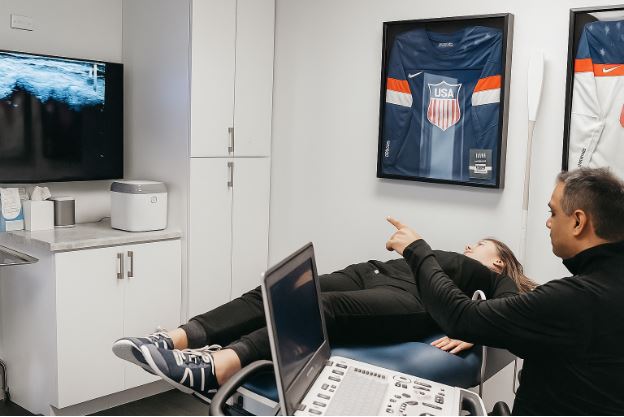
MRI is excellent for static images—ultrasound is superior for real‑time movement, soft tissue strain, surface-level cartilage behavior, and tendon function.
This gives us live, dynamic insight into how your knee functions in the movements that actually matter.
Your knee pain isn’t caused by standing still—so we don’t evaluate you standing still.
We measure cadence, stride, ground reaction patterns, downhill load, and posture.
We assess knee tracking, seat height alignment, hip stability, and quad dominance.
We analyze squat mechanics, stance width, and hinge patterns.
We test rotational stability, descent tolerance, and knee flexion load.
This level of diagnostic precision is why our knee outcomes are consistent, predictable, and long‑lasting.
Knee pain is not one condition — it is dozens of biomechanically and biologically different problems. Treating them all the same way (as many clinics do) leads to poor outcomes.
At Dynamic Athlete, we treat knee pain based on the exact tissue involved and the mechanics that caused the overload.
Below is a breakdown of the most common conditions we see in Boulder’s active adults, along with how they present and how we approach them.
Each of these conditions requires a different targeted plan.
This is why we do NOT treat knee pain with a one‑size‑fits‑all approach.
Your knee is evaluated based on:
This is what leads to predictable, successful outcomes.
One of the biggest misconceptions in regenerative and non‑surgical orthopedics is the belief that treatments like PRP, “stem cells,” or shockwave therapy are standardized. They are not. The quality, methodology, dosing, technology, and operator skill vary dramatically from clinic to clinic — and these differences often determine whether a patient succeeds or fails.
In Boulder, the problem is amplified because many active adults are highly motivated and have already tried multiple providers before reaching us. They are often told a version of: “You’ve tried everything. Surgery is your next step.” The reality is that most have never received a true medical‑grade regenerative procedure.
Dynamic Athlete does not provide generic injections or device‑based protocols. We provide precision biologic medicine delivered with a level of clinician skill and diagnostic clarity that fundamentally changes the outcome.
High-quality PRP can only be produced with high‑quality systems and operator skill.
This is why our PRP outcomes outperform regional clinics.
Many clinics advertise “BMAC stem cell therapy” — a term that is outdated, inaccurate, and misleading.
BMA is not for joint cushioning — MFAT is.
BMA is for stalled tendon and ligament healing.
This is a level of precision competitors rarely match.
MFAT fails when used for the wrong problem — or when overprocessed.
The term “shockwave” is misused everywhere.
Most clinics offer radial pressure waves (RPW) but advertise it as true shockwave.
Many clinics own only RPW — the least effective of the three.
Dynamic Athlete owns the entire full‑stack shockwave system, making us the regional leader and ASTI training center.
A biologic injected into the wrong plane produces no result.
A shockwave protocol applied to the wrong region fails.
PRP injected without imaging is guesswork.
MFAT placed without structural understanding cannot succeed.
This is why Dynamic Athlete is the most trusted clinic for active adults seeking nonsurgical knee pain resolution.
Once we identify the exact tissue involved and the mechanical factors behind your knee pain, we select the most appropriate treatment. We do not start with injections. We start with diagnostic clarity — and then apply the biologic or mechanical intervention that makes the most sense.
Below are the treatment options we use, and the logic behind each one.

We use FRP, which provides a fibrin scaffold that stabilizes the healing response.
We never combine BMA with MFAT.
MFAT is the right choice when the problem is joint‑dominant — not tendon‑dominant.
This combination accelerates healing faster than any single modality.
No biologic succeeds without movement logic.
Our goal is not just pain relief — it’s durable performance.
Active adults in Boulder don’t just want pain relief — they want durability, performance, confidence on terrain, and the ability to return to the sports that define their lifestyle. Our outcomes-focused model is designed around predictable healing timelines based on the biologic used, tissue severity, training load, and sport-specific demands.
We divide expected results into three phases: early response, biologic remodeling, and long-term durability.
“Things aren’t perfect yet, but I feel less guarded.”
This is where real structural change occurs.
“I can do more with less payback.”
This is the performance phase — where you regain true athletic confidence.
Most athletes consider this the “I feel like myself again” milestone.
Biologic remodeling doesn’t stop at 12 weeks — it continues for nearly a year.
This durability is why our biologics outperform cortisone, gel shots, and generic regenerative care.
When these pieces align, outcomes are consistent, predictable, and long-lasting — which is why our knee results set the regional standard.
Yes. The majority of knee conditions we treat — including tendinopathy, cartilage irritation, synovial inflammation, and non-surgical meniscus issues — respond extremely well to biologics (PRP, BMA, or MFAT) combined with shockwave and movement optimization. Most patients who come to us have been told surgery is their only option, and they improve without it.
We determine this through:
We do NOT choose a biologic based on guesswork or package deals.
We pick the biologic that directly matches the tissue biology.
Several critical differences:
Patients come to us from across Colorado for this higher standard.
Those treatments often:
If you’ve tried other injections and still have pain, you’re the exact patient we help the most.
Yes.
Our protocols are based on evidence and adapted for active adults.
It depends on:
General expectations:
We treat mild to moderate osteoarthritis exceptionally well.
Severe OA cases require a different approach, and we provide honest guidance on whether biologics can help.
You don’t need to be a competitive athlete.
If you walk, hike, ski, lift, or simply want a pain-free active lifestyle, you will benefit from our model.
We are a premium outcomes-focused clinic.
We do not compete on price — we compete on results.
Our patients value:
Not all regenerative medicine is the same — and price rarely reflects quality in this field.
Book a medical-grade knee evaluation:
With degrees and backgrounds in both Interior Design and Business, Nicole brought Dynamic Athlete’s office space to life – transforming an empty shell of a space into the sleek, sports boutique you see now.
She handles all things non-clinical and keeps Dynamic Athlete running behind the scenes. Having grown up in Arkansas, Nicole takes care of our patients with a genuine Southern hospitality you won’t find anywhere else.
Always looking to learn and grow, Nicole loves to travel and experience new cultures, take classes on new skills or just experiment at home with baking, knitting, sewing, gardening, you name it.
Rachel graduated high school this year and will be attending the University of Wyoming in the fall to pursue a pre-medical track. She hopes to go on to medical school afterwards to specialize in orthopedics and sports medicine.
Rachel found her passion for this field through many sports injuries growing up, and hopes to help other athletes overcome the challenges she has faced. In her free time (when she’s not injured), Rachel enjoys running, lifting weights and spending time with her family.
Olivia is an intern for Dynamic Athlete and has been with us since August 2023. She is professional ice skating coach and ice program director, working with hockey skaters and figure skaters of all ages and backgrounds. She is passionate about psychology and incorporating mental health into coaching, training, and injury recovery.
Olivia received her Bachelors of Science in Cognitive Neuroscience Psychology from the University of Denver and was a student athlete on their figure skating team. She is seeking to pursue a masters degree in Sports and Performance Psychology so she can continue to serve the athletes in her community.
When Olivia isn’t assisting with Dynamic Athlete, she enjoys traveling, attending Colorado Avalanche games, spending time with friends and family, and being creative through photography and modeling.