
Hip pain affects nearly every type of athlete in Boulder. Runners feel it during long climbs or descents. Cyclists experience deep anterior tightness after intense training blocks. Lifters notice irritation during squats, lunges, or hinge work. Skiers feel stiffness after long days on variable terrain, while hikers experience sharpness or fatigue on steep grades.
The hip is the most powerful and complex joint in the body, connecting rotational mechanics, torso stability, and lower‑extremity force production. When it breaks down, everything downstream becomes unstable — the knee, ankle, and even the lumbar spine.
Active adults require something far more precise.
Dynamic Athlete specializes in medical‑grade hip diagnostics and regenerative care, combining:
Dynamic Athlete is a premium, outcomes‑first clinic.
We are not a place to price shop — we are a destination for people who want their hip pain fixed correctly the first time.
Boulder’s athletes place unique demands on the hip joint. The combination of altitude, steep terrain, high training volume, and year‑round activity creates a load profile unmatched in most cities.
Below are the most common biomechanical drivers of hip pain in Boulder:
Hip pain is almost never a single‑structure issue.
This is why generic PT or simple stretching fails.
Dynamic Athlete uses medical‑grade ultrasound and movement‑driven assessment to find the precise source — and deliver the correct biologic or shockwave treatment.
Hip pain is one of the most misdiagnosed conditions in orthopedic medicine, especially among active adults. The hip is not a simple joint — it is a deep, multi‑planar structure with overlapping layers of muscle, tendon, fascia, capsule, labrum, and neurovascular pathways. When evaluations are rushed or incomplete, the wrong tissue gets blamed — and the wrong treatment gets chosen.
Dynamic Athlete’s diagnostic process is designed for Boulder’s high‑demand population.
We do not guess.
We measure, visualize, load‑test, and map the true driver of pain.
MRI is a snapshot.
Ultrasound is a living exam that shows pathology in motion.
Many hip problems originate above or below the joint.
We correlate these findings with ultrasound to identify not only what is injured, but why it is overloaded.
This determines whether a biologic (PRP, BMA, MFAT) or full‑stack shockwave is appropriate — or whether both are required in sequence.
This is why Dynamic Athlete excels at treating hip pain in Boulder’s active adult population.
Hip pain is rarely “just hip pain.”
It is almost always a multi‑layered condition involving tendon overload, capsular irritation, rotational imbalance, or deep gluteal dysfunction.
Below are the conditions Dynamic Athlete treats most effectively.
Hip pain is complex — but it is treatable.
Dynamic Athlete delivers medical-grade, tissue-specific regenerative care that resolves the root cause of hip pain and restores long-term durability.
Most active adults in Boulder are told the same generic pathway for hip pain: rest, stretching, NSAIDs, basic PT, and cortisone. When these fail, they’re told the problem is “impingement” or “arthritis,” and surgery becomes the default suggestion.
This approach fails because it treats the hip as a simple hinge, not a multi‑layered system.
At Dynamic Athlete, we emphasize a core truth:
Not all hip treatments are the same — and the quality of the biologic, the precision of the injection, and the accuracy of the diagnosis determine the outcome.
Below is exactly how our premium, evidence-based, medically advanced approach differs from every other clinic in Colorado.
Our PRP is engineered, not improvised.
Many Colorado clinics still advertise “BMAC stem cells” — a misleading and outdated term.
We do **not** combine BMA with MFAT.
We choose the correct biologic based on tissue type — not marketing.
MFAT is not a tendon treatment.
It is a joint treatment.
Many clinics misuse MFAT, causing poor outcomes.
Dynamic Athlete uses MFAT only when the hip joint is the true pain generator.
We do not treat hip pain with just one device.
Most clinics only use RPW.
Some offer ESWT but lack EMTT.
None combine all three with precision sequencing.
This is why we are the full‑stack shockwave training center for Colorado.
A biologic placed in the wrong plane will not work.
Dynamic Athlete is a premium, outcomes-first regenerative medicine clinic.
We do not compete on price — we compete on precision, expertise, and results.
This section ensures patients understand:
Not all regenerative procedures are the same — and choosing the wrong clinic leads to poor outcomes.
Once we identify the exact structure causing hip pain, we build a treatment plan tailored to the tissue, the athlete, and the sport demands. Hip pain improves only when the biologic matches the biology — and when the loading plan matches the athlete’s goals.
Below is Dynamic Athlete’s medical-grade, tissue-specific treatment framework.
We use FRP — the highest-quality PRP system — to ensure consistency and durability.
This is used only when PRP alone is insufficient.
MFAT is never combined with BMA.
This restores long-term performance.
Hip pain resolves when the right biologic meets the right tissue – supported by targeted shockwave & strategic loading.
This is the Dynamic Athlete approach: clear, precise, evidence-based, and engineered for Boulder’s active adults.
Hip pain improves when the correct tissue is identified, the correct biologic or shockwave treatment is applied, and the correct loading strategy is followed. Boulder’s active adults respond exceptionally well to this model because they value consistency, movement, and long-term durability.
Healing occurs in four predictable phases:
This phase feels like:
“Something is changing — the pain isn’t running the show anymore.”
This is when major tissue remodeling begins.
This phase feels like:
“I can train again — with control.”
This is the most important phase for active adults.
This is where PRP, BMA, MFAT, and shockwave deliver their deepest benefits.
True biologic remodeling continues for months.
This is where Dynamic Athlete’s approach outperforms cortisone, rest, PT-only, and generic regenerative clinics.
Hip pain resolves — and performance returns.
The correct sequence (diagnostics → biologics/shockwave → loading → durability) creates predictable, long-lasting results. Boulder’s active adults thrive with this model.
Yes.
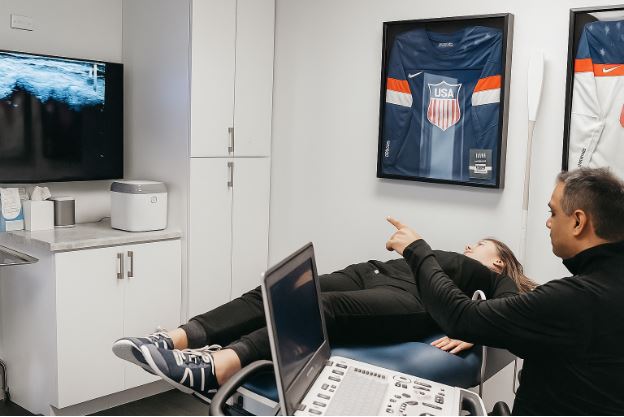
We use medical-grade ultrasound to evaluate tendon fibers, bursae, joint irritation, and capsular structures.
This ensures the biologic or shockwave treatment is matched to the exact tissue.
Cortisone reduces pain temporarily but weakens collagen.
PT can help, but only if the correct tissue is being treated.
Most patients who come to Dynamic Athlete have:
No.
Most PRP is low quality, poorly concentrated, and not guided by ultrasound.
Dynamic Athlete uses:
This dramatically improves outcomes.
They are never combined.
We choose based on the biology, not marketing terms.
No — it accelerates results but does not replace biologics.
Shockwave is excellent for tendon remodeling and deep irritation, but biologics address structural issues more directly.
Typical ranges:
Yes — with guided modifications.
We do not shut athletes down; we adjust load, strengthen the right tissues, and ensure mechanics support healing.
Yes — because we deliver premium care with superior outcomes.
We do not compete on price.
We compete on precision, expertise, and long-term durability.
Book a medical-grade hip evaluation with ultrasound, movement testing, and a personalized treatment plan.
With degrees and backgrounds in both Interior Design and Business, Nicole brought Dynamic Athlete’s office space to life – transforming an empty shell of a space into the sleek, sports boutique you see now.
She handles all things non-clinical and keeps Dynamic Athlete running behind the scenes. Having grown up in Arkansas, Nicole takes care of our patients with a genuine Southern hospitality you won’t find anywhere else.
Always looking to learn and grow, Nicole loves to travel and experience new cultures, take classes on new skills or just experiment at home with baking, knitting, sewing, gardening, you name it.
Rachel graduated high school this year and will be attending the University of Wyoming in the fall to pursue a pre-medical track. She hopes to go on to medical school afterwards to specialize in orthopedics and sports medicine.
Rachel found her passion for this field through many sports injuries growing up, and hopes to help other athletes overcome the challenges she has faced. In her free time (when she’s not injured), Rachel enjoys running, lifting weights and spending time with her family.
Olivia is an intern for Dynamic Athlete and has been with us since August 2023. She is professional ice skating coach and ice program director, working with hockey skaters and figure skaters of all ages and backgrounds. She is passionate about psychology and incorporating mental health into coaching, training, and injury recovery.
Olivia received her Bachelors of Science in Cognitive Neuroscience Psychology from the University of Denver and was a student athlete on their figure skating team. She is seeking to pursue a masters degree in Sports and Performance Psychology so she can continue to serve the athletes in her community.
When Olivia isn’t assisting with Dynamic Athlete, she enjoys traveling, attending Colorado Avalanche games, spending time with friends and family, and being creative through photography and modeling.